



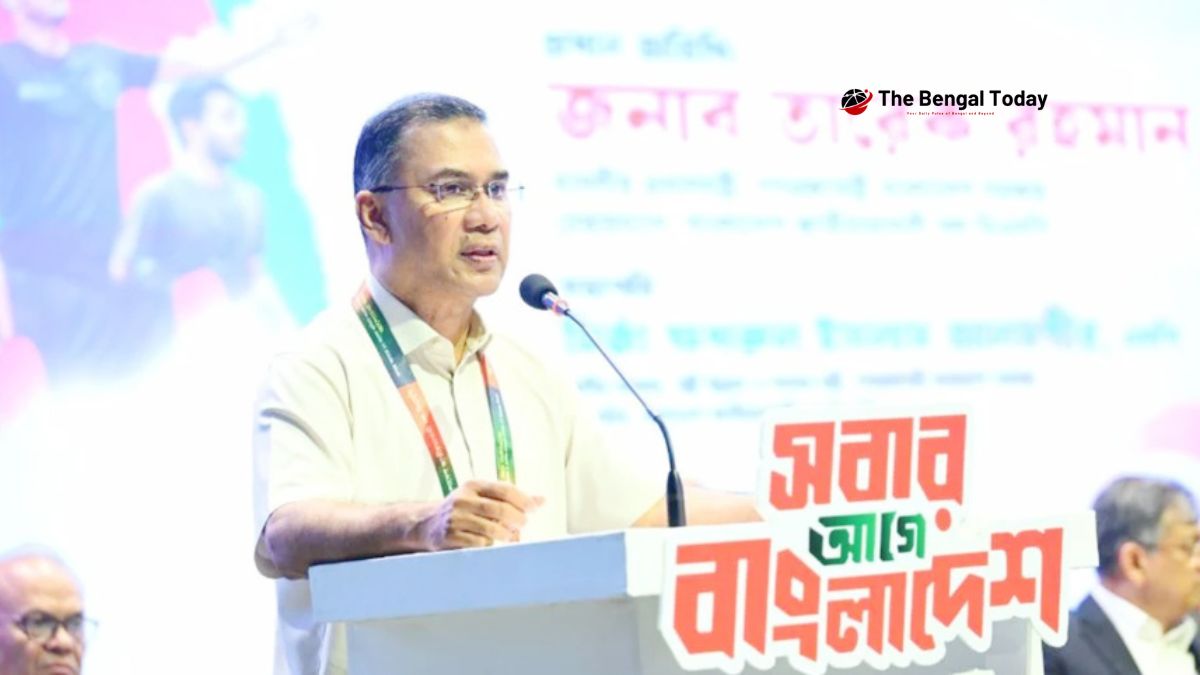
Prime Minister Tarique Rahman stated that the July Mass Uprising belongs neither to a single political party nor to an individual, but rather its primary credit goes to the people of the country. He made these remarks as the chief guest on Tuesday (August 4) afternoon at the Krishibid Institution Bangladesh (KIB) during a discussion titled “17 Years of Unrelenting Struggle to Restore Democracy and the Blood-Soaked July Awakening.”
The head of government remarked, “Various people have made different statements at different times to confuse the public regarding the July movement. We have stated clearly from our side—the credit for the July uprising belongs solely to the people of this country. It is not the credit of any single individual or political party. We remained on the ground over the past 17 years; we never abandoned the field, nor did we ever leave the people behind.”
He further added, “If we look at world history, every movement builds up gradually until the public spontaneously joins in. The July-August uprising developed in the exact same manner. The movement succeeded because the people demanded change.”
Addressing the topic of state reforms, Prime Minister Tarique Rahman noted, “When we first began talking about reforms, most political parties in Bangladesh were not addressing the issue. Our proposed reform measures gradually culminated into the 31-point program. Under the previous fascist regime, an average of $16 billion was siphoned out of the country annually.”
He further highlighted that the banking, healthcare, and agricultural sectors were completely devastated during the previous regime. Acknowledging that the public is currently suffering due to this shattered economic and administrative situation, he assured that the government is exerting every effort to rescue citizens from these hardships as quickly as possible.
Highlighting the fragile state of the healthcare sector alongside future action plans, the Prime Minister announced:
Shortfall at the Upazila Level: He expressed deep regret that even after so many years of independence, kidney dialysis facilities have failed to reach the upazila level.
Short-Term Plan (3–6 Months): Within the next 3 to 6 months, 50-bed dialysis units will be established in districts housing medical colleges, and 10-bed units will be set up in District General Hospitals.
Long-Term Plan (2–3 Years): A comprehensive plan has been initiated to launch 10-bed dialysis services at every upazila level across the country within the next 2 to 3 years.

