



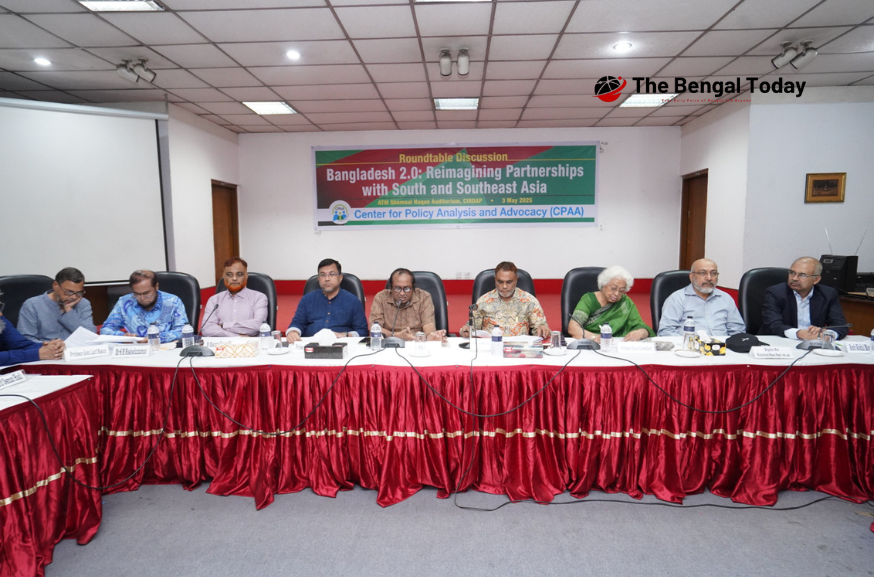
The Center for Policy Analysis and Advancement (CPAA) organized a roundtable discussion last Saturday titled “Bangladesh 2.0: Rethinking Partnerships with South and Southeast Asia.”
The roundtable was chaired by CPAA President and foreign affairs analyst Dr. Shariful Alam. Participants in the discussion included Professor Shahiduzzaman from the Department of International Relations at the University of Dhaka, Professor Niloy Pradhan from the Department of Political Science at Jahangirnagar University, Pro-Vice Chancellor of Patuakhali Science and Technology University Abdul Latif Basu, Director of the Research and Training Wing of the Ministry of Foreign Affairs Ambassador Abdul Motaleb Sarkar, retired Brigadier General Mohammad Harun, country director of the Asia Foundation’s Bangladesh Chapter, representatives from the South Asian Institute of Policy and Governance (SIPG), AIINPNJ, and journalists from Prothom Alo, Bonik Barta, and The Business Standard. Young researcher Ali Ahnaf Jewel and media activist Sharif Uddin Hossain (ENKLOV) were also present.
The keynote paper was presented by international affairs analyst Dr. Zaidul Roni. He stated that post-independence Bangladesh has failed to strategically define and execute its foreign policy. However, in recent years, Bangladesh’s geostrategic importance in the Indo-Pacific region has been steadily increasing. Therefore, the time has come for Bangladesh to begin sharpening and asserting a more distinct and independent foreign policy.
Speakers at the discussion emphasized that a reassessment of political, economic, and diplomatic ties is essential to redefine Bangladesh’s role in the new geoeconomic landscape of South Asia. This calls for rebuilding economic and academic networks with South and Southeast Asian nations. To meet future challenges, they stressed the importance of crafting a participatory, youth-led, and citizen-centric regional policy framework.
They also noted that the Bay of Bengal corridor is becoming a critical node in geoeconomics and geopolitics, with Bangladesh playing a central role. The time is ripe to rebuild ties with South Asia, prioritize soft power diplomacy, engage youth, and integrate local voices into policy-making processes. Additionally, Bangladesh must broaden its horizons in areas such as the blue economy, green growth, innovation, research, and trade and connectivity with emerging economies like Vietnam, Thailand, and Australia.
Ambassador Motaleb Sarkar noted that currently 25% of global trade flows through South Asia. The region contributes 11% of global GDP, and when combined with Southeast Asia, represents 34% of the world economy. Hence, regionalism holds a promising future, and Bangladesh must leverage its youthful workforce to become an active stakeholder in broader regional markets.
Media representatives emphasized the importance of engaging the youth in reestablishing an independent foreign policy. They also suggested that new communication frameworks must focus on skill development, climate diplomacy, food security, and fair trade. At the same time, Bangladesh should strengthen its presence in regional platforms such as BIMSTEC and IORA.
In conclusion, the discussants asserted that as part of “Bangladesh 2.0,” the country’s foreign policy must become proactive, youth-inclusive, and Indo-Pacific-oriented. Furthermore, Bangladesh must reposition itself in South and Southeast Asia through equitable partnerships and enhanced cooperation.

