



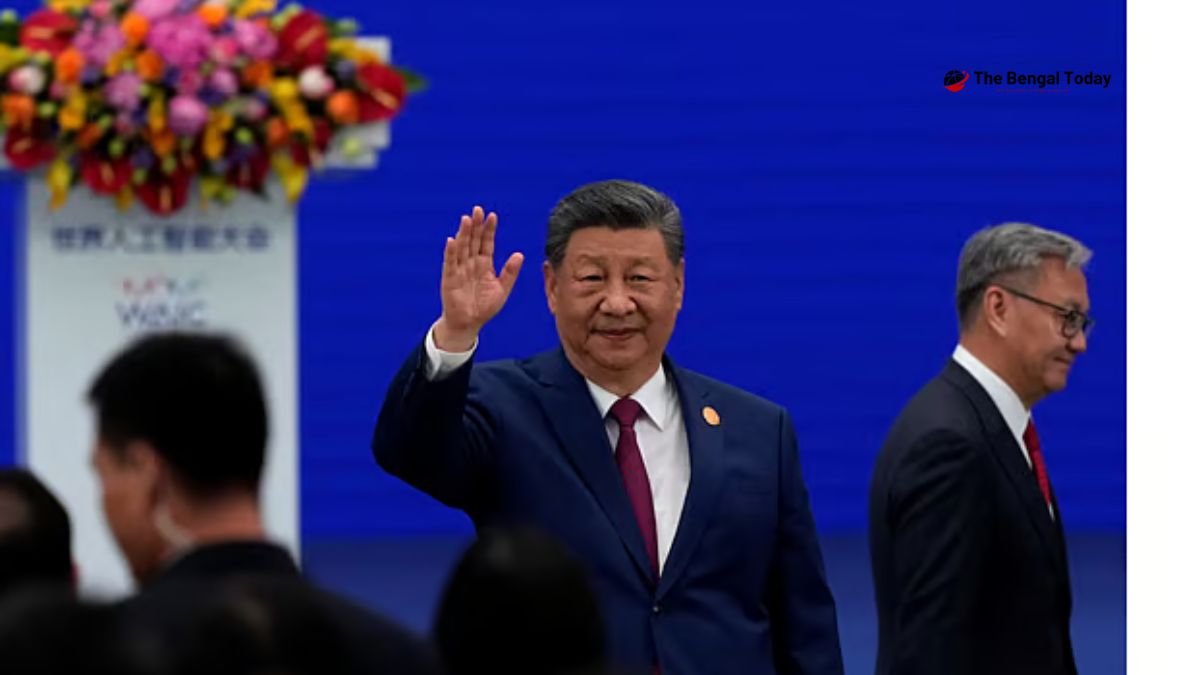
In a massive geopolitical masterstroke aimed at establishing dominance over the global governance and regulation of Artificial Intelligence, Beijing has officially launched a powerful 29-nation coalition. The World Artificial Intelligence Cooperation Organization (WAICO) made its debut during the opening ceremony of the four-day World Artificial Intelligence Conference (WAIC) held in Shanghai.
According to global analysts, this move is a direct challenge to Washington’s singular influence over the development and regulation of rapidly evolving technologies, positioning Beijing as the undisputed leader of a new global AI framework.
“A Symphony of International Cooperation, Not a Solo Show” — Xi Jinping
First launched in 2018, this year marks the ninth edition of the conference, running under the theme “AI Partnership for a Brighter Future.”
In a video address at the opening ceremony, Chinese President Xi Jinping issued a stern warning against unilateral attempts to establish exclusive dominance over the technology. Experts view his pointed remarks as a direct jab at the United States.
“The development of AI should not be a solo performance by any single country,” President Xi stated. “It should be a symphony of international cooperation.”
He further emphasized that the global community must jointly oppose the practice of “overstretching the concept of national security” or placing the security of one nation above that of others in the AI sector. Additionally, Xi underscored a “human-centric” approach, calling for robust regulatory frameworks, technical oversight, and early warning systems to guarantee that “AI remains under human control at all times.”
What is ‘WAICO’ and Who is in the Alliance?
The World Artificial Intelligence Cooperation Organization (WAICO) is an intergovernmental body officially established on Thursday (July 16). The signing ceremony for the Shanghai-based organization was attended by high-profile international dignitaries, including UN Secretary-General António Guterres.
The organization’s stated objective is to strengthen international cooperation and develop safe, beneficial AI policies across member states. Notably, the alliance’s 29 founding members prominently feature key nations from the Global South, including:
🇮🇩 Indonesia
🇧🇷 Brazil
🇲🇾 Malaysia
🇿🇦 South Africa
🇸🇳 Senegal
🇷🇺 Russia
🇵🇰 Pakistan
The Escalating ‘Chip War’: Strengths and Capabilities
Advanced chips and semiconductors serve as the backbone of AI technology, and the bilateral trade war between the two superpowers over this sector has reached a boiling point.
US Sanctions: Citing national security concerns this past May, the US Department of Commerce reiterated its decision to restrict the export of critical semiconductors and technology to Chinese parent companies and their subsidiaries.
China’s Countermeasure: In retaliation, Beijing banned the export of dual-use technologies and critical rare earth minerals—essential for chip manufacturing—to American companies.
China’s Strategic Advantages:
While China still lags slightly behind the United States in sourcing the most cutting-edge semiconductors, Beijing holds unique advantages in two critical areas:
Massive Data Centers & Mineral Supremacy: China commands the massive data center capacity required to train and run large AI models, and it retains a near-monopoly over the global supply chain of rare earth minerals needed to build chips.
Abundant, Low-Cost Energy: To meet the immense electricity demands of AI, strategic state investment in infrastructure has allowed China to produce more than double the electricity of the United States, a gap projected to widen.
On the very first day of the conference, China showcased state-of-the-art AI models and technologies designed to compete directly with Silicon Valley. As global adoption of Chinese-developed AI models steadily grows, the battle between Washington and Beijing over the future of artificial intelligence governance is bound to take an even more dramatic turn.

