



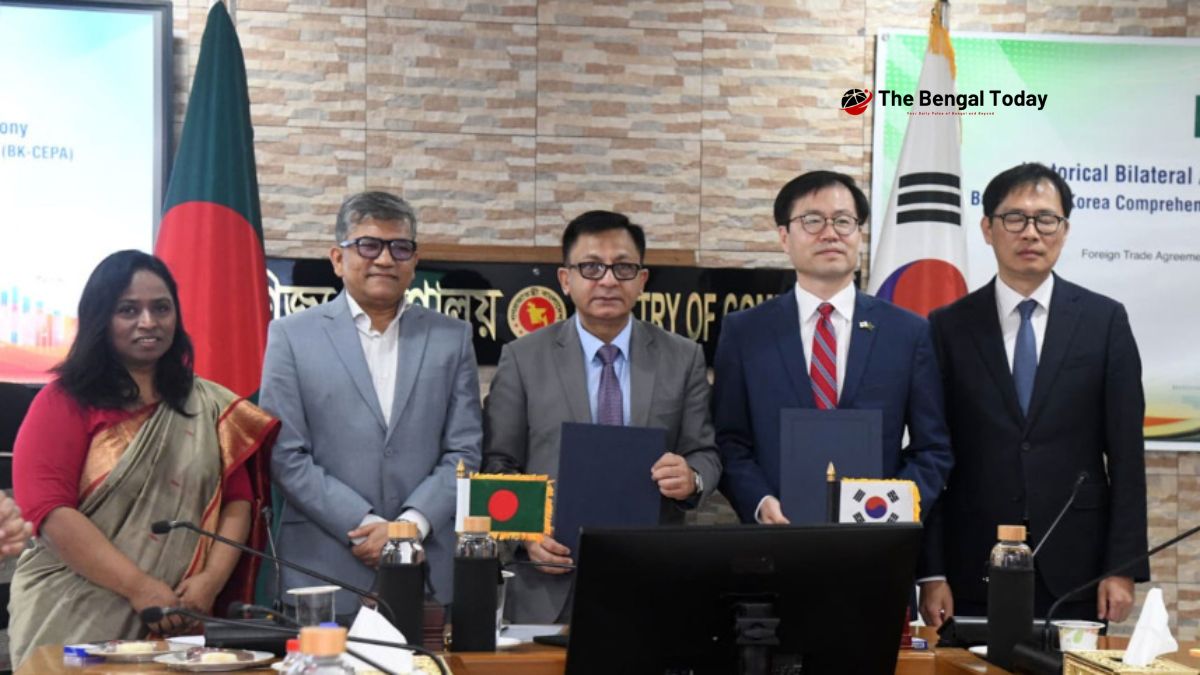
The long-awaited Comprehensive Economic Partnership Agreement (CEPA) between Bangladesh and South Korea has been officially finalized. Following a year of intensive negotiations, this landmark joint declaration was announced on Tuesday. The Ministry of Commerce confirmed that the agreement will officially take effect once the necessary legal and institutional approval procedures are completed.
Upon implementation, 8,428 Bangladeshi products will gain immediate duty-free access to the South Korean market from day one. In return, South Korea will enjoy similar access for 1,054 products in the Bangladeshi market. Overall, 97 percent of Bangladeshi goods and services will receive preferential treatment in South Korea, while 87 percent of South Korean products will enjoy reciprocal advantages in Bangladesh.
Speaking at a press conference in the conference room of the Ministry of Commerce at the Bangladesh Secretariat, Commerce Minister Khondokar Abdul Muktadir stated, “The current government has successfully concluded negotiations for such a high-caliber trade agreement with one of the world’s largest economies in just five months. As a result, Bangladeshi ready-made garments, leather and leather goods, jute, footwear, pharmaceuticals, and home textiles will gain a more competitive edge in the South Korean market.”
He further noted that this CEPA will serve as a catalyst for boosting trade and investment toward achieving the target of elevating Bangladesh to a $1 trillion economy by 2034.
South Korean Trade Minister Yeo Han-koo remarked, “The 56-year economic relationship between Bangladesh and Korea was primarily anchored in the textile sector. Now is the time to expand this partnership into new horizons, including technology, supply chains, industrial cooperation, and investment.” He expressed optimism that once CEPA comes into force, Korean companies will show significantly greater interest in investing in Bangladesh.
Meanwhile, industry experts have urged the implementation and simplification of digital lending processes to bring small and medium enterprise (SME) entrepreneurs—the key drivers of the country’s economic growth—under the formal financial umbrella. The call was made on Monday at a seminar titled “Simplifying SME Loans through Digital Payment Systems and Digital Loan Processing,” jointly organized by the SME Foundation and The Asia Foundation at a hotel in Dhaka.
Key findings presented at the seminar include:
Economic Contribution: The CMSME sector contributes approximately 30 percent to the nation’s GDP.
Loan Distribution Reality: Out of more than 11.7 million CMSME entrepreneurs, only 9 percent receive direct bank loans, while 14 percent access credit through Microfinance Institutions (MFIs).
Financially Excluded: Nearly 77 percent of SME entrepreneurs remain excluded from formal institutional credit, preventing many promising enterprises from scaling up.
To bridge this gap, the SME Foundation and The Asia Foundation are jointly executing a project. Its primary objectives are to reduce the information asymmetry between entrepreneurs and financial institutions, expand the use of fintech services, and facilitate faster loan approvals through AI-based alternative credit scoring methodologies.
Chaired by Anwar Hossain Chowdhury, Managing Director of the SME Foundation, the seminar featured addresses by Dr. Md. Kabir Ahmed, Deputy Governor of Bangladesh Bank, and Khalid Mahmud Khan, Member of the Board of Directors of the SME Foundation, among others.

