



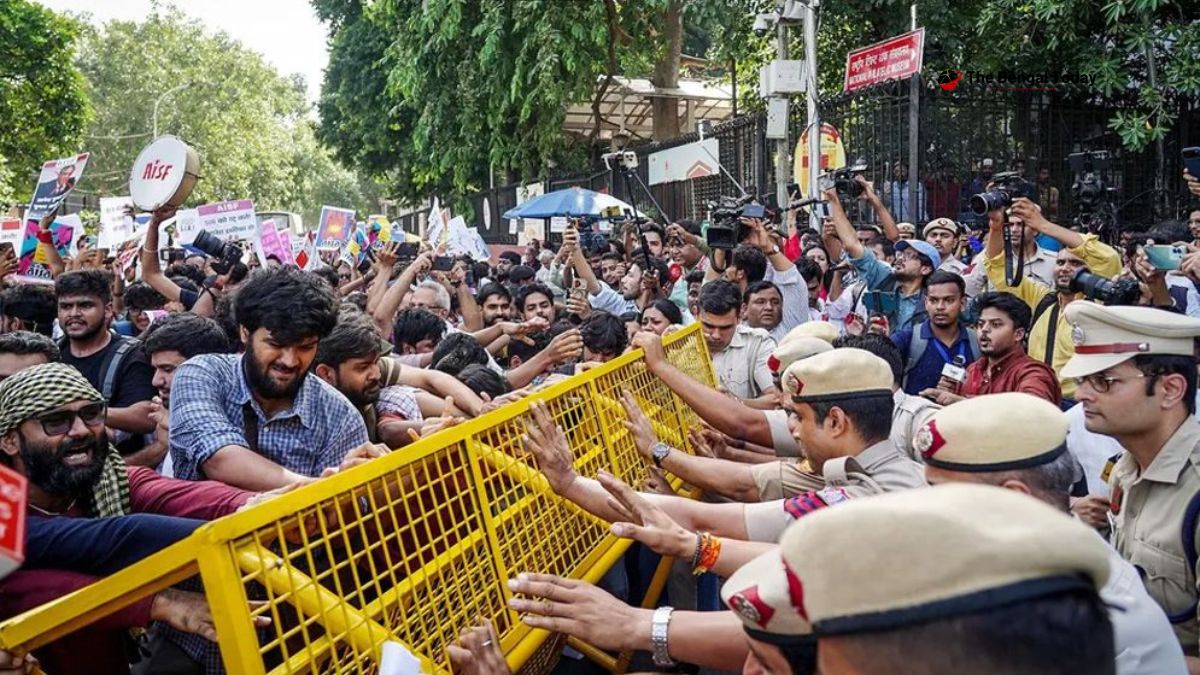
Security measures have been unprecedentedly tightened in India’s capital, New Delhi, following a third consecutive day of protests demanding the resignation of Chief Election Commissioner (CEC) Gyanesh Kumar. Centered around two scheduled protest marches on Sunday (October 4, 2026), Delhi Police deployed approximately 5,000 personnel—including the Rapid Action Force (RAF) and other paramilitary units—across the central administrative zone surrounding India Gate and Jantar Mantar.
Delhi Police confirmed that no official permission had been granted for any march or gathering between India Gate and historical Jantar Mantar. Nevertheless, law enforcement agencies anticipated large crowds of citizens and opposition activists.
To maintain control, New Delhi Police administration and the Ministry of Home Affairs implemented several security and legal protocols:
Dual Marches & Street Roadblocks: Two separate rallies—the ‘Citizens March’ at 3:00 PM and the ‘Indian Youth Congress’ rally at 5:00 PM—were announced. To block protesters from reaching Jantar Mantar, multi-layered barbed-wire barricades were erected across key arterial routes, including Tolstoy Marg, Janpath Road, Sansad Marg, Kerala House, Ashoka Road, and the C-Hexagon.
Drone Surveillance & Riot Control Gear: Police Control Room (PCR) vans remain stationed along all approaches to Jantar Mantar. Live feeds are being monitored at the District Deputy Commissioner of Police (DCP) office via CCTV, while drones assess crowd movement from above. Personnel deployed at the site have been equipped with modern riot-control gear.
FIRs & Crime Branch Investigation: Delhi Police registered three separate First Information Reports (FIRs) against demonstrators over recent unrest at Jantar Mantar. Conversely, police received three serious allegations against officers regarding sexual harassment of female protesters and journalists on duty. These complaints have been transferred to the Delhi Police Crime Branch for detailed investigation.

