



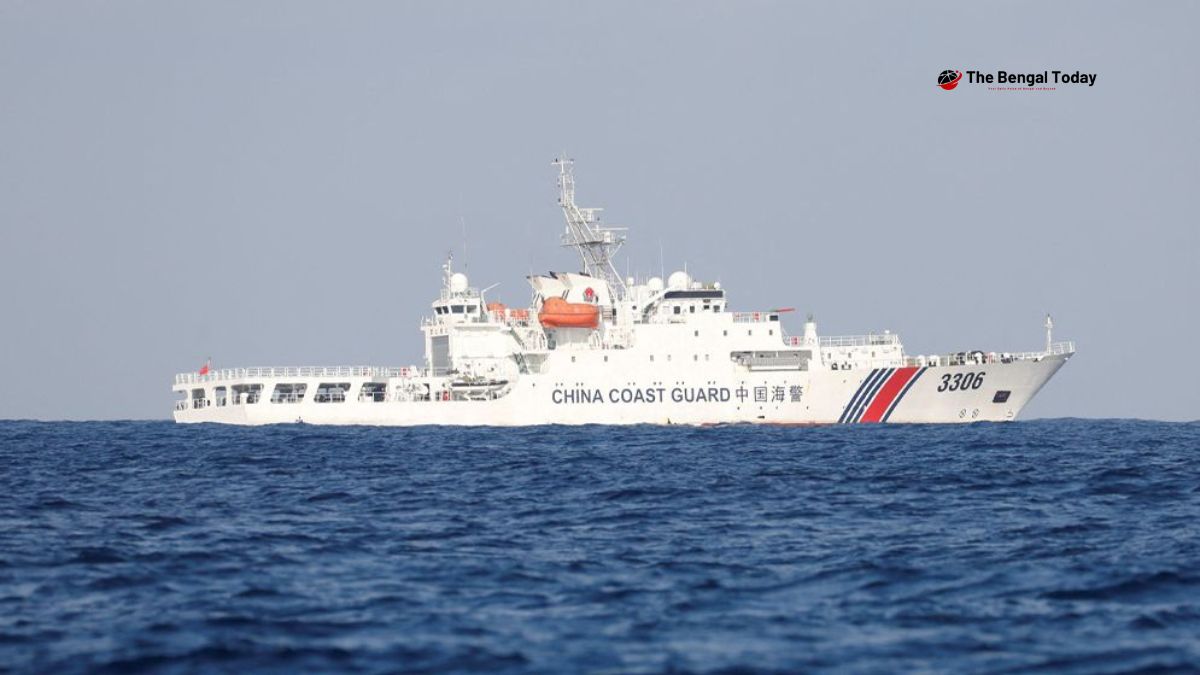
Renewed geopolitical friction has erupted between Beijing and Washington following the presence of a U.S. warship near the contested Sabina Shoal in the strategically vital South China Sea. China’s military officially announced on Tuesday (October 20) that naval and air units were deployed to track, monitor, and issue warnings to the U.S. vessel for entering waters adjacent to the Spratly Islands without prior authorization.
According to global news agency reports, the naval maneuver was executed as part of the United States Navy’s routine Freedom of Navigation Operations (FONOPs) to challenge excessive maritime claims and uphold international navigational rights.
USS Charleston Entry & Beijing’s Objection: The Southern Theater Command of the Chinese People’s Liberation Army (PLA) confirmed that the littoral combat ship USS Charleston entered waters near Sabina Shoal early Tuesday morning. Beijing condemned the maneuver as a direct violation of China’s territorial sovereignty and national security.
Military Tracking & Stern Warning: PLA Southern Theater Command stated that maritime and aerial assets were mobilized to monitor the warship’s movements continuously. Beijing called on Washington to immediately cease such “provocative actions” that jeopardize regional peace and stability.
The Philippines Factor & U.S. Mutual Defense Treaty: Sabina Shoal—part of the Spratly Islands—is claimed by China, the Philippines, Vietnam, Malaysia, and Taiwan. Last month, tensions flared near the shoal following a collision between a Chinese Coast Guard vessel and a Philippine resupply boat. With the U.S.-Philippines Mutual Defense Treaty in place, localized disputes carry significant international security risks.
First Known FONOP in Over a Year: While the U.S. Navy did not issue an immediate formal statement, FONOPs are routinely conducted to defend freedom of navigation in international waterways. Reports note this is the first documented U.S. freedom-of-navigation operation in the South China Sea in over a year.

