



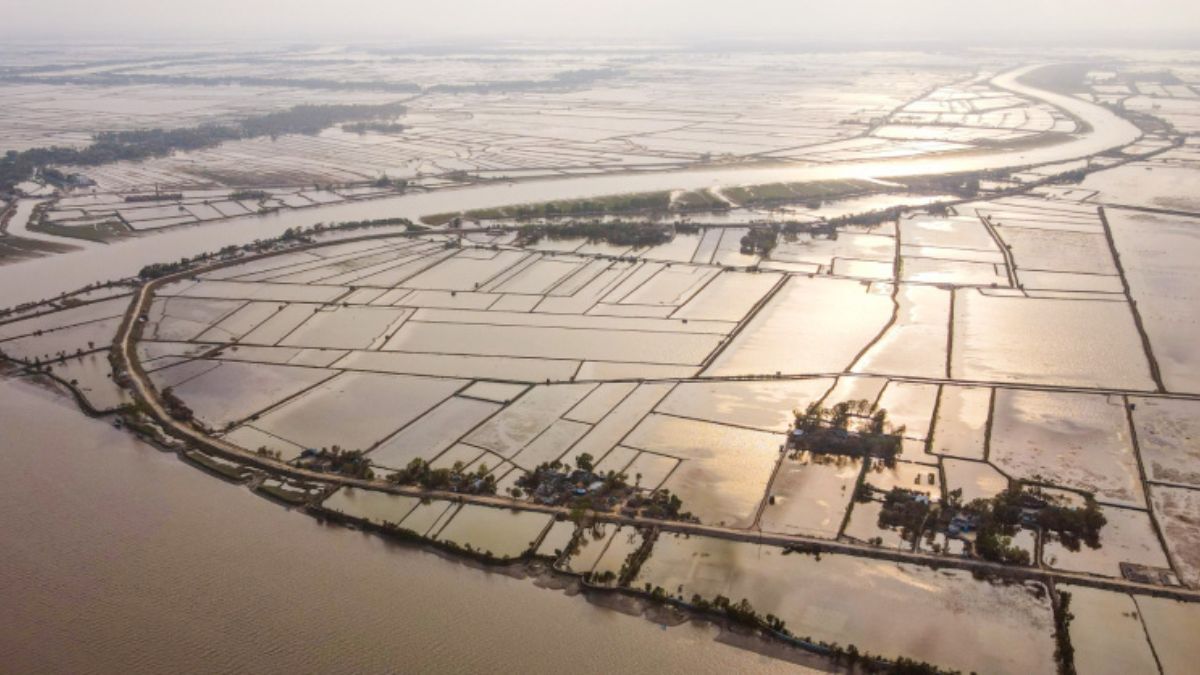
Saltwater is rapidly intruding into Bangladesh’s southwestern region, affecting nearly 68 percent of cultivable land across 18 out of 19 coastal districts, according to a recent government study. Experts warn that escalating soil and groundwater contamination poses a severe threat to national food security and the livelihoods of millions.
Data from the Soil Salinity Map of Bangladesh 2024, prepared by the Soil Resource Development Institute (SRDI), reveals that at least 11.56 lakh hectares out of 17.03 lakh hectares of cultivable land in the region degraded due to salinity up to 2024. This marks a sharp increase from 10.56 lakh hectares recorded in 2009.
In just 15 years, one lakh hectares (1,000 square kilometers)—an area roughly equivalent to the size of Munshiganj district—have turned saline. By comparison, the country’s first post-independence assessment in 1973 recorded 8.33 lakh hectares of saline-affected land.
Expanding Reach Beyond the Coast
Speaking to The Daily Star, Ameer Md Zahid, Chief Scientific Officer (CSO) and Divisional Head at SRDI, expressed deep concern over the trend:
“It is worrying that both the area and intensity of salinity intrusion in the coastal zone are increasing day by day.”
Salinity has emerged as one of the gravest climate threats to the coastal belt, which encompasses nearly a third of Bangladesh’s total land area and supports approximately 4.38 crore people. Local communities are already struggling with falling crop yields, dwindling drinking water supplies, and deteriorating living conditions.
Alarmingly, the 2024 study reveals that salinity is moving further inland into non-coastal districts:
Newly Affected Areas: Kashiani and Muksudpur in Gopalganj, alongside Jashore Sadar, have appeared on the national salinity map for the first time.
At-Risk Zones: The study warns that Alfadanga in Faridpur and Mohammadpur in Magura could soon face saltwater intrusion as sea levels continue to rise.
Urgent Action Required
The study, conducted over a two-year period, underscores how rising salinity is compounding pressure on Bangladesh’s agricultural land, which is already contracting due to rapid urbanization.
“If urgent measures are not taken now, more areas will become saline, posing a serious threat to agricultural production and food security,” warned Zahid, who led the research team.

