



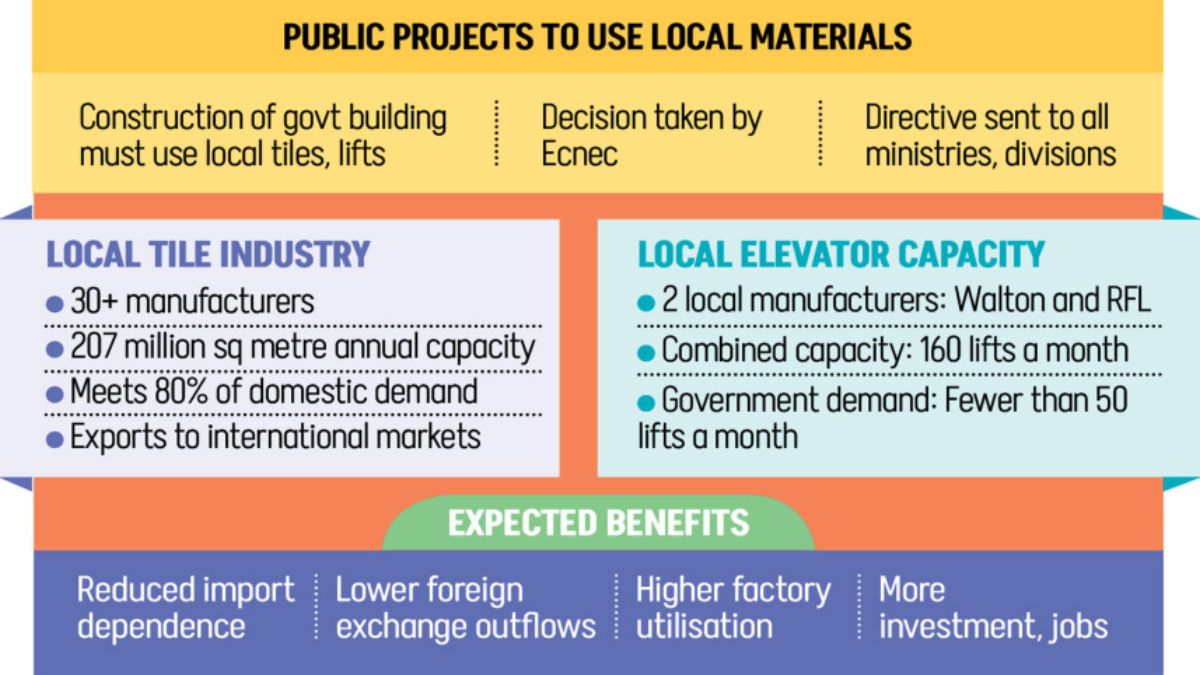
In a major policy decision aimed at strengthening domestic manufacturing and curbing foreign exchange outflows, the government’s highest project approval body has made the use of locally manufactured tiles and elevators mandatory for all public building construction projects, effectively banning imported alternatives where local capacity exists.
The directive was finalized during a meeting of the Executive Committee of the National Economic Council (Ecnec) chaired by Prime Minister Tarique Rahman, according to Planning Commission documents. The decision has already been formally circulated across all ministries and government divisions for immediate compliance.
Industry leaders and manufacturers have enthusiastically welcomed the mandate, projecting that it will breathe new life into local industrial sectors struggling with sluggish market demand.
While public procurement guidelines have long encouraged government agencies to prioritize local products—as demonstrated in mega-projects like the Padma Bridge and Dhaka Metro Rail—this latest directive explicitly targets the elevator and ceramic tile sectors, where domestic producers face substantial overcapacity.
A senior Planning Commission official, speaking on condition of anonymity, emphasized that strategic government procurement is essential for sustaining local industries that have made heavy capital investments.
“If Bangladesh aims for world-class infrastructure, we must clearly define required standards for domestic producers,” the official noted, citing the construction of Dhaka Airport’s Third Terminal, where local suppliers successfully provided steel, cement, bricks, and sand meeting rigorous Japanese engineering standards. “If local manufacturers can satisfy those specifications, there is no rationale for imports. We should rely on foreign sourcing only when domestic technical capability is absent.”
The official further highlighted the need to transition from importing fully assembled elevators to developing domestic assembly and technical capabilities. By importing high-quality components and assembling lifts locally, the country could slash procurement costs by nearly 50 percent while facilitating technology transfer.
The ceramic industry—which produces high-grade tiles, sanitary ware, and tableware for both domestic and global markets—views the Ecnec directive as a crucial lifeline against fierce import competition.
Md Mamunur Rashid, Additional Managing Director of X Ceramic Group, stated that the mandate comes at a critical time when manufacturers, burdened by idle capacity, have been forced into aggressive price wars to meet operational overheads and debt obligations.
“This is a milestone decision for domestic producers,” Rashid commented. “Locally manufactured tiles are engineered to withstand Bangladesh’s specific climatic conditions and often surpass imported alternatives in durability. Restricting imports will absorb excess capacity and stabilize the market.”
Reinforcing this sentiment, Md Rafiqul Islam Rony, Director of Marketing and Sales at BRB Cable Industries Ltd, pointed out that local manufacturers across building material sectors possess full capacity to meet national demand.
“Replacing imports with local products ensures capital remains within the domestic economy, boosts tax revenues, creates employment, and drives industrial expansion,” Rony remarked, emphasizing that local quality is frequently superior to imported substitutes.

