



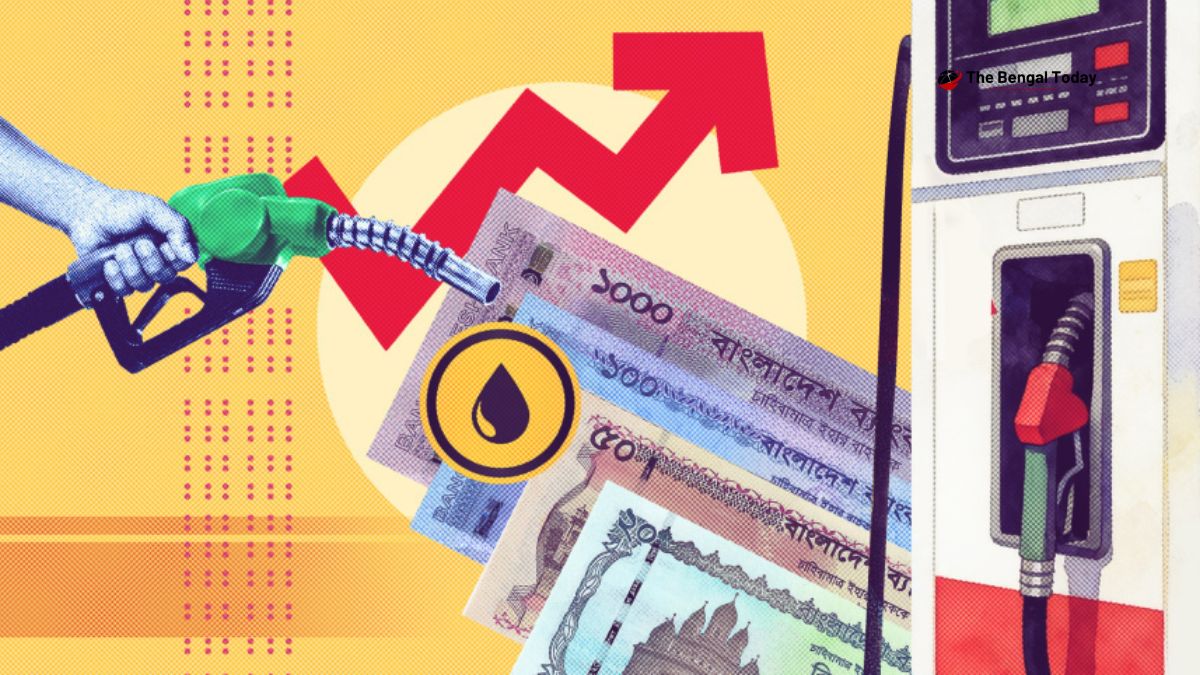
Raising fuel prices is usually enough to dent any government’s popularity. Higher fuel costs drive up transport fares, inflate the prices of daily necessities, elevate the cost of living, and spark resentment even at local tea stalls. Naturally, opposition parties seize this as a major political opportunity.
Despite these risks, almost every oil-importing country in Asia was forced to make this difficult decision this year. It was the only viable way to curb massive financial losses that had been accumulating for a prolonged period.
A significant portion of the world’s oil passes through the Strait of Hormuz, with much of it bound for Asia. Consequently, any disruption along this shipping route hits countries like Bangladesh first. Recent disruptions triggered a sharp surge in international diesel prices, directly impacting the domestic market. This situation left governments facing a tough dilemma: pass the burden of higher costs onto the public immediately, or adopt strategies to keep the losses hidden from view.
Bangladesh opted for a combination of both strategies. In April, the government raised the price of diesel by BDT 15 to BDT 115 per liter. After keeping it stable at that level for five months, the price was raised further to BDT 135 per liter on September 21. Diesel serves as the primary engine of the country’s economy, accounting for roughly 65% of total fuel sales by the Bangladesh Petroleum Corporation (BPC).
According to the Ministry of Power, Energy, and Mineral Resources, international fuel prices more than doubled since March. Additionally, regional instability caused shipping freight rates to skyrocket. As a result, BPC recorded a cumulative loss of BDT 22,876 crore between March and August.
Officials estimate that the revised prices could reduce annual losses by approximately BDT 10,000 crore. Furthermore, this move is expected to conserve foreign exchange reserves and help curb fuel smuggling to neighboring countries where prices remain significantly higher.
However, the core issue lies elsewhere. Keeping fuel prices artificially low does not eliminate government losses; rather, it increases public debt and delays payments to energy suppliers. While maintaining low pump prices may seem consumer-friendly on the surface, it often serves as a tactical move to keep fiscal pressure hidden from public sight.
Bangladesh imports nearly 95% of its total oil requirements and 30% of its natural gas. As a result, the domestic market is entirely exposed to global price fluctuations, meaning any international price hike inevitably trickles down to domestic consumers.
This raises two fundamental questions: Why are we following an erratic price adjustment mechanism? And what safeguards exist for those unable to absorb these sudden price shocks?
Looking at how neighboring Asian countries are managing similar energy crises provides useful context:
Pakistan: Pakistan adjusts fuel prices daily in alignment with international market rates. Between September 1 and September 18, diesel prices rose from approximately PKR 371 to PKR 425 per liter. Although rigorous, this mechanism offers complete transparency. To ease the burden on ordinary citizens, the government provided a targeted subsidy of PKR 100 per liter for motorcycles, autorickshaws, and small commercial vehicles.
Sri Lanka: Drawing lessons from its severe 2022 energy crisis, Sri Lanka implemented a structured policy. After gradually increasing diesel prices between March and May, the government reduced domestic prices as soon as global prices eased in late June. This demonstrated a two-way adjustment policy that moves both upward and downward. Additionally, Sri Lanka maintained targeted support for the transport and fisheries sectors alongside social safety nets for low-income households.
India: Avoiding immediate price hikes resulted in substantial revenue losses for India. In March, the government reduced excise duties to keep pump prices stable, asking state-owned refiners to absorb the losses. However, holding prices constant despite rising crude costs led to state oil companies losing an estimated INR 2,400 crore daily before post-election adjustments were made.
Southeast Asia:
Philippines: The Philippines allowed prices to float according to market dynamics while providing direct financial relief to public transport operators and drivers.
Malaysia: Malaysia adjusted diesel prices while continuing to subsidize petrol for general citizens.
Indonesia: Under President Prabowo Subianto, Jakarta adopted a dual strategy—letting premium fuel prices reflect market rates while maintaining subsidized fuel options to protect lower- and middle-income groups, despite the budgetary strain.
Ultimately, citizens across these nations bear the cost in one way or another. The main differences lie in how transparently the price hikes are managed, whether adjustments are made systematically, and who bears the brunt of the burden.
Where did Bangladesh’s approach fall short? While adjusting fuel prices may be economically necessary, three major issues stand out:
Unpredictable and Inconsistent Pricing Mechanism: In 2024, following IMF recommendations, Bangladesh adopted an automated pricing formula to avoid sudden price shocks. However, ad-hoc adjustments made in April, June, and September deviated from this framework. This inconsistency creates market uncertainty, leading businesses to raise prices preemptively in anticipation of further increases.
Inadequate Adjustment Margin: According to BRAC EPL, the gap between international market rates and domestic diesel prices was around BDT 89 per liter. Raising the price by BDT 20 leaves diesel priced well below its true market value. Consequently, the government faces political backlash while BPC’s financial deficit remains largely unresolved.
Absence of Safety Nets: Perhaps the most critical oversight was the lack of targeted relief. While countries like Pakistan, Sri Lanka, and Malaysia introduced concessions or support programs for transport workers, fishermen, and low-income groups, Bangladesh implemented price increases without immediate safety nets or buffer mechanisms.
A key tool to mitigate this impact could have been the ‘Farmer Card’ initiative. Since preliminary work had already been completed, the necessary infrastructure is in place. Following a pilot program in April that provided BDT 2,500 in assistance to 22,000 farmers, an expanded rollout targeting 110,364 farmers was scheduled for September 17—just three days before the latest price hike. However, the launch was postponed without a rescheduled date.
With the Boro rice irrigation season starting in December, expediting farmer registration is crucial. Providing direct financial assistance for irrigation through the Farmer Card can help offset higher diesel costs and soften the economic blow on the agricultural sector.
The inflationary risks associated with fuel price hikes require careful attention. When diesel and kerosene prices were raised by 42.5% in 2022—the largest single-day increase in Bangladesh’s history—inflation stood at 7.48%. Within a week, prices of 25 out of 26 essential commodities rose by up to 14%, pushing inflation to a decade-high level in the following month.
Current economic conditions remain sensitive. The Asian Development Bank (ADB) has cautioned that rising energy costs and supply pressures could push Bangladesh’s inflation rate back up toward 9% in the current fiscal year.
To navigate these challenges effectively, priority should be given to:
Reinstating a transparent and automated fuel pricing formula.
Communicating price adjustment schedules clearly to prevent market speculation.
Accelerating targeted relief programs like the ‘Farmer Card’ to protect vulnerable groups and small-scale producers.

